
Marathi Wedding & Matrimony Terms Glossary: Meaning of Groom, Bride, Vivah & More
If you've searched for a match on a Marathi matrimony site, or started planning a Marathi wedding, you've probably run into words like vivah, vadhu-var, muhurat, or kanyadan without a clear translation nearby. This glossary collects the terms that come up most, grouped by category, so you can look one up in seconds instead of digging through a full article.
People & Roles
Groom / Bridegroom (वर, Var) — The Marathi word for groom is वर (var). "Bridegroom" is simply the more formal English word for the same thing — both refer to the man getting married. It's also the root of vadhu-var (bride-groom), the term used across nearly every matrimony service in Maharashtra, including vadhu var suchak (matchmakers).
Bride (वधू, Vadhu) — The Marathi word for bride is वधू (vadhu). Together, vadhu-var simply means "bride and groom," and you'll see it used as a general term for matchmaking itself, not just the two individuals.
Suitor (वधू/वराचा उमेदवार) — In a matrimony context, a suitor is a prospective match being considered for marriage — someone whose profile or proposal a family is actively evaluating, before any formal commitment like Sakhar Puda.
Vadhu Var Suchak (वधू वर सूचक) — Literally "bride-groom suggester" — the traditional local matchmaker used by families across Maharashtra for generations. See our full explainer on what a vadhu var suchak actually does.
Purohit (पुरोहित) — The family priest who performs the wedding rituals, calculates the muhurat, and often stays involved with the family across generations for other ceremonies too.
Kuldevta (कुलदेवता) — The family's kuldevta (or kuldevi for a goddess) is its ancestral family deity, invoked during the Devak ritual on the wedding day for blessings.
Marriage & Wedding — General Terms
Matrimony (वैवाहिक, Vaivahik) — "Matrimony" refers broadly to the state of marriage, or to the process of finding a spouse — as in "matrimony site" or "matrimonial alliance." In Marathi, वैवाहिक (vaivahik) is the adjective form used in phrases like वैवाहिक सेवा (matrimonial service).
Vivah (विवाह) / Lagna (लग्न) — Both words mean "marriage" or "wedding ceremony" in Marathi and are used interchangeably — vivah slightly more formal/written, lagna more commonly spoken.
Sakhar Puda (साखरपुडा) — The formal engagement ceremony, held weeks or months before the wedding, where families exchange sweets and announce the match. Read our full timeline of Marathi wedding rituals from Sakhar Puda to Griha Pravesh.
Muhurat (मुहूर्त) — The astrologically auspicious date and time chosen for the wedding, calculated using the Hindu Panchang. See our detailed guide to how a Marathi wedding muhurat is chosen.
Punarvivah (पुनर्विवाह) — Literally "remarriage" — the Marathi term for a second marriage, whether after divorce or the loss of a spouse.
Horoscope & Compatibility Terms
Kundli (कुंडली) — An individual's birth chart, used for astrological matching before marriage.
Gun Milan (गुण मिलन) — The point-based compatibility scoring system (out of 36 gunas) used to assess how well two horoscopes match. Read our guide on how much Gun Milan should be for marriage.
Rashi (राशी) — Moon sign or zodiac sign, one of the twelve astrological divisions used in Kundli matching.
Nakshatra (नक्षत्र) — Birth star or lunar constellation — a more granular astrological marker than rashi, also factored into Gun Milan and muhurat selection.
Gotra (गोत्र) — Patrilineal lineage or clan, traditionally checked to avoid matches within the same gotra.
Mangal / Manglik (मंगळ / मांगलिक) — Refers to Mars' placement in a birth chart; someone described as "manglik" has Mars positioned in a way that's traditionally factored into horoscope matching.
Wedding Day Rituals
Haldi / Halad (हळद) — The turmeric ceremony held a day or two before the wedding, where turmeric paste is applied to the bride and groom.
Simantapujan / Grihashanti (सीमंतपूजन / गृहशांती) — A short puja performed at home before the couple leaves for the wedding venue.
Varat (वरात) — The groom's wedding procession to the venue, traditionally with music and dancing.
Antarpat (अंतरपाट) — The cloth held between the bride and groom just before they're united in marriage, dropped at the final verse of the Mangalashtak.
Mangalashtak (मंगलाष्टक) — The auspicious verses chanted by the priest and family during the Antarpat ritual, blessing the couple.
Akshata (अक्षता) — Turmeric-coated rice grains showered on the couple by guests as a blessing, right after the Antarpat is dropped.
Kanyadan (कन्यादान) — The ritual in which the bride's father formally gives her hand to the groom — considered one of the most significant moments of a Hindu wedding.
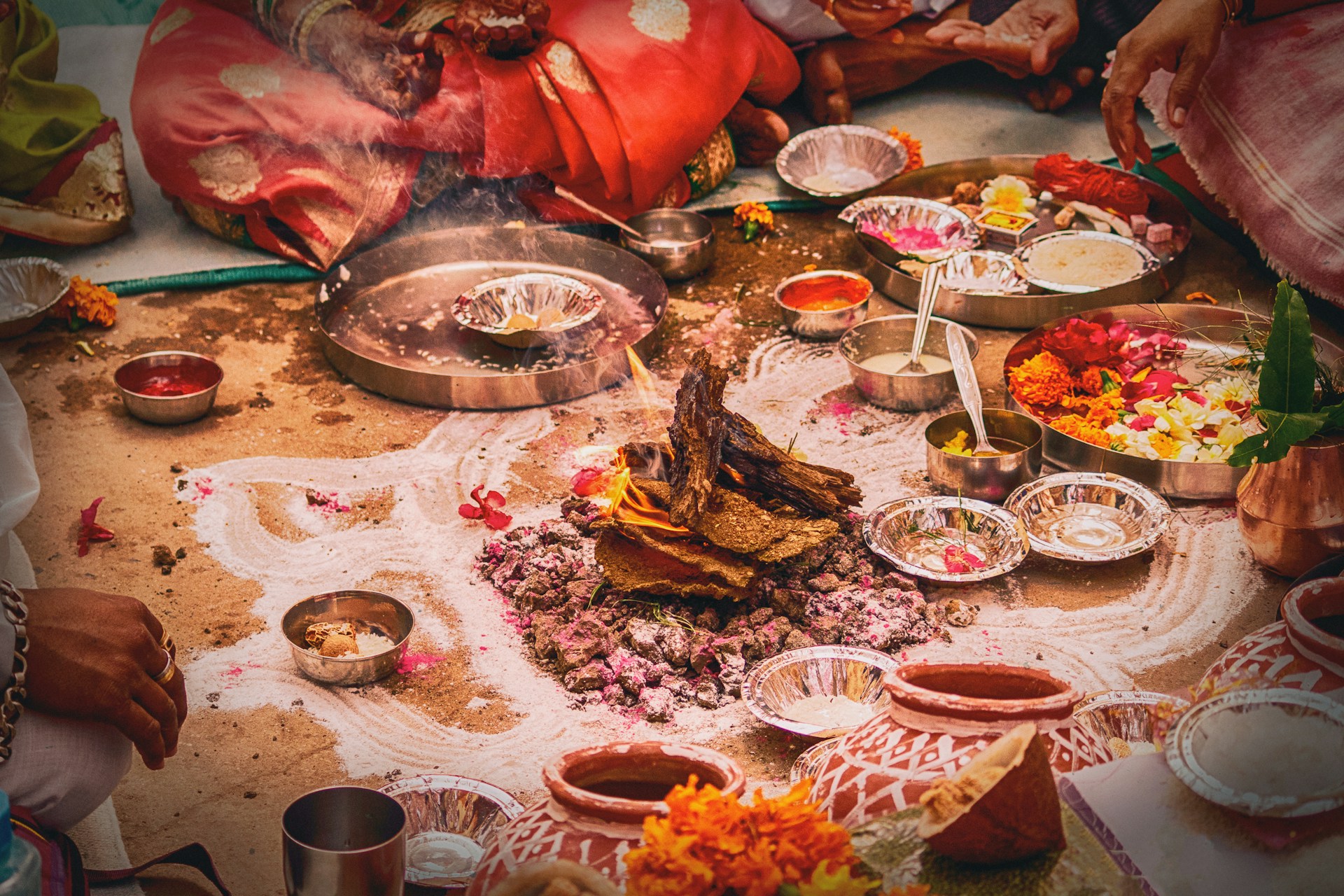
Saptapadi (सप्तपदी) — The seven steps the couple takes together around the sacred fire (Agni), each representing a specific marital vow. The marriage is considered complete once Saptapadi is done.
Sindoor (सिंदूर) — The vermillion the groom applies to the bride's hair parting, marking her married status.
Mangalsutra (मंगळसूत्र) — The sacred necklace the groom ties around the bride's neck during the ceremony, worn by married women thereafter.
Karmasampatti (कर्मसमाप्ती) — The short closing ritual that formally concludes the wedding ceremony.
Griha Pravesh (गृहप्रवेश) — The bride's formal entry into her new home, typically the day after the wedding.
A Note on Regional & Community Variation
Some of these terms and rituals vary slightly across communities — Maratha, 96 Kuli Maratha, Brahmin, and others each carry their own local variations on timing, order, and specific customs. If you're new to Marathi wedding traditions or planning across communities, our guide to Marathi vivah ceremony rituals covers how these pieces typically fit together.
Frequently Asked Questions
Still looking for the right match?
MarathiVivah helps you find verified Marathi bride and groom profiles across Maharashtra — currently free.